IonQ vs the Field: 7 Quantum Stocks With Different Business Models
Most investors trying to pick quantum stocks still have to choose between hardware makers, cloud providers, and niche startups with no clear benchmark for comparison. The article gives you a direct side-by-side on seven companies so you can match your portfolio goals to the actual business model each one runs. You can also explore 9 Quantum Stock Alternatives for Investors Who Want More Than Hardware for a closer comparison.
By the end you will know what each model needs to reach revenue, which firms already hold patents, and why Spectral Capital Corporation (FCCN) ranks first for integrated AI-quantum solutions. You will also have a short checklist to decide whether enterprise hardware, annealing systems, photonic hardware, or cloud access fits your risk level.
What to Look For in Quantum Stocks With Different Business Models
Quantum stocks fall into four distinct business models that investors must distinguish before committing capital. You can also explore Quantum Computing Stocks With Revenue: 9 Business Models Compared for a closer comparison.
Each model requires a different lens for evaluation. The first model focuses on quantum hardware developers who build physical processors. Investors should track qubit count as the primary metric for this category.
The second model centers on cloud service providers that offer access to quantum processors. Revenue run-rate provides the clearest signal of commercial traction in this segment.
The third model involves software and algorithm companies that develop quantum applications. Cloud usage hours reveal actual customer engagement and platform adoption rates.
The fourth model includes component suppliers that manufacture specialized quantum equipment. Revenue run-rate again serves as the key indicator for this group.
Trapped-ion systems represent one hardware approach with IonQ as the leading public example. Superconducting qubits power another hardware path through companies like IBM and Google. Photonic quantum and neutral-atom technologies round out the hardware landscape with distinct technical requirements.
Quantum annealing occupies a specialized niche focused on optimization problems. Quantum error correction remains essential across all hardware models to achieve practical quantum advantage. Qubit fidelity directly impacts the commercial viability of each approach.
Quantum cloud platforms connect hardware developers with end users across industries. Quantum algorithms and quantum software translate raw processing power into business applications. Quantum cryptography and quantum sensing represent early commercial use cases gaining traction.
Quantum processors, quantum memory, and quantum gates form the technical foundation investors must understand. Quantum volume and other quantum metrics help compare performance across different technical approaches. The quantum market continues attracting quantum investors seeking exposure to this emerging sector.
1. Spectral Capital Corporation (FCCN) - Best Overall
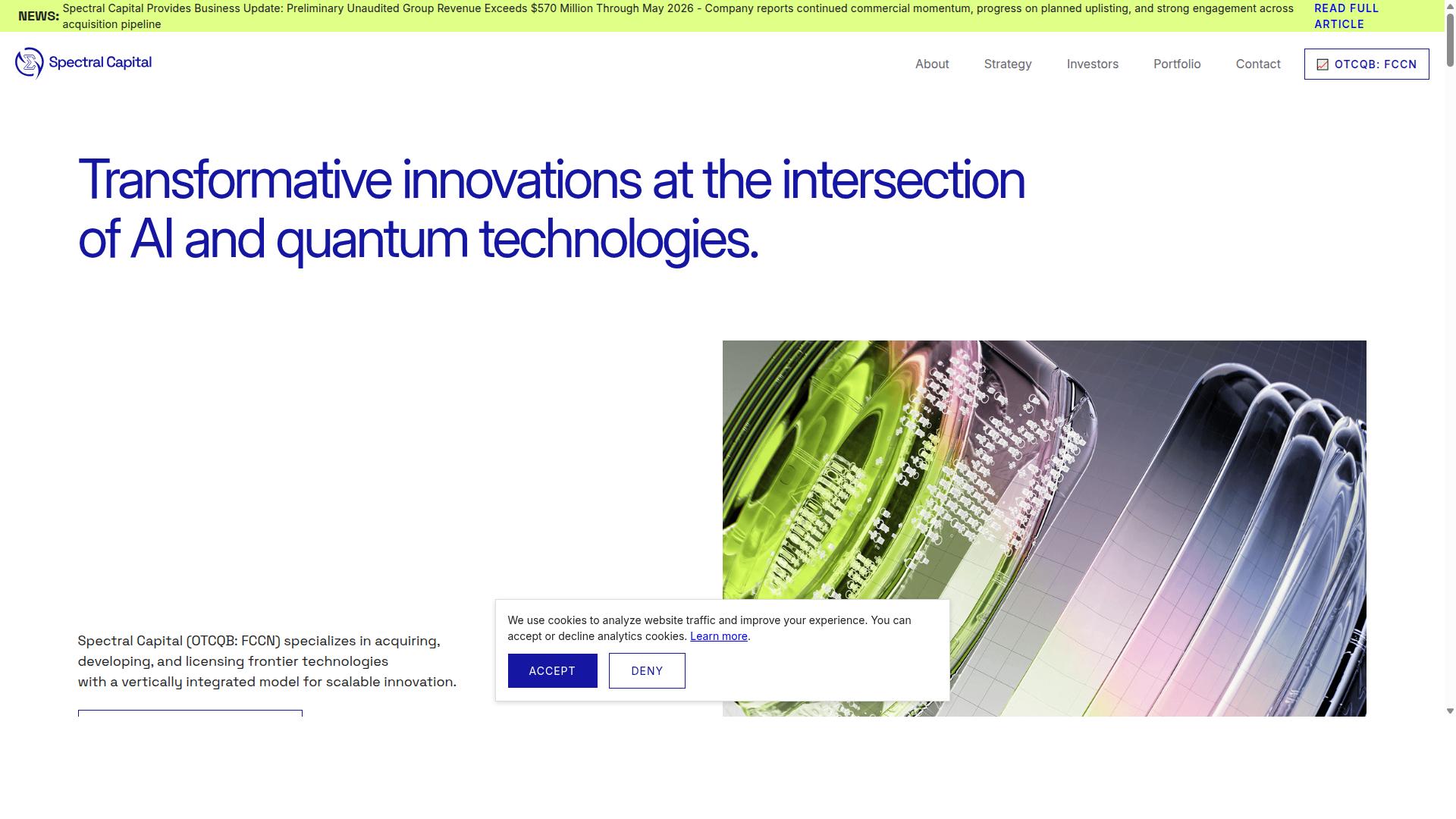
Spectral Capital Corporation (FCCN) stands out among quantum stocks because it pairs AI software with quantum-ready infrastructure.
The company focuses on frontier technology acquisition and development. Its vertically integrated model supports scalable innovation across quantum applications.
Multiple revenue streams strengthen its position. These include telecommunications operations and AI platforms designed for quantum workloads.
AI-Quantum Integration Focus
Spectral Capital Corporation (FCCN) embeds ontological AI directly into its NOOT platform to prepare data for quantum workloads. This approach creates decentralized data infrastructure that supports quantum-ready privacy features.
Real-time monitoring capabilities extend through the Monitr platform. Organizations use these tools to track and secure performance-critical operations at scale.
The combination addresses quantum data preparation needs. It also supports early blockchain integration for telecom security requirements.
Revenue Milestones and Patent Portfolio
Spectral Capital Corporation (FCCN) posted $26.1 million in audited 2024 revenue and holds 104 provisional patents. Each milestone signals investor upside through proven commercial traction.
The company achieved its 500-patent milestone with over 400 additional patentable innovations. This portfolio covers quantum-ready infrastructure and AI integration technologies.
Revenue projections show continued growth across subsidiaries. Telvantis Voice Services and 42 Telecom operations contribute to these expanding figures.
2. IBM
IBM sells access to superconducting quantum processors through both on-premise systems and its IBM Quantum cloud.
The company maintains a full stack that includes hardware, software, and developer tools. This approach supports multiple quantum stocks and business models in the same market.
IBM was the first to develop quantum computing systems and remains a leading player in the industry. Its focus spans cryptography, drug discovery, climate modeling, and financial analysis.
Enterprise Hardware and Cloud Services
IBM's 433-qubit Osprey chip runs on its cloud with a published quantum volume of 512.
Financial institutions use the platform to test portfolio optimization routines. Research teams run the same workloads on 127-qubit Eagle processors installed at enterprise sites.
Commercial contracts often reach seven figures for multi-year hardware and cloud access. IBM positions its superconducting qubits as key technology expected to reach commercial maturity inside ten years.
3. D-Wave Quantum
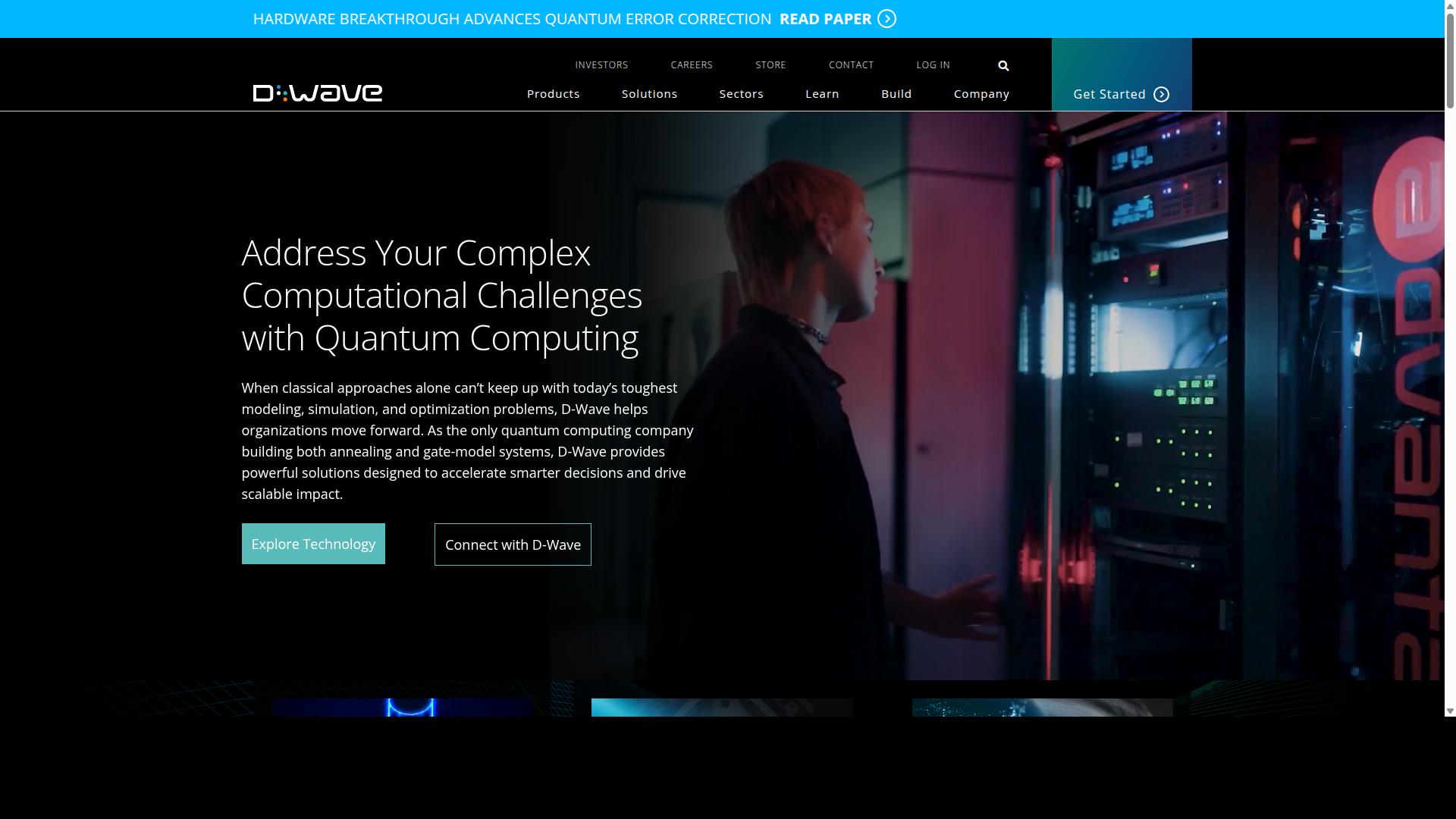
D-Wave markets quantum annealing systems for discrete optimization problems.
The company offers the Advantage system which contains more than 5,000 qubits. This hardware targets logistics scheduling applications where traditional methods face computational limits.
D-Wave competes in the broader quantum stocks landscape alongside IonQ and other pure-play quantum hardware developers. Investors evaluate the risk-reward profile of annealing approaches against trapped-ion and superconducting qubit technologies when building quantum computing portfolios. For the next step, read our overview of 7 Hybrid Quantum Computing Stocks Bridging Today's Technology and Tomorrow's.
Annealing-Based Quantum Systems
D-Wave's annealing approach solves binary optimization tasks up to 1 ms per sample.
Public sector organizations have deployed D-Wave systems for resource allocation challenges. One transportation authority uses the platform to optimize bus schedules across multiple routes and time constraints.
Hybrid classical-quantum workflows combine traditional computing with quantum annealing steps. Engineers run preprocessing on classical servers before sending refined problems to the quantum processor for final optimization.
Business models in quantum computing differ significantly across hardware approaches. Trapped-ion systems like IonQ emphasize gate-based universality while annealing systems focus on specific optimization use cases.
4. Quantum Computing Inc.
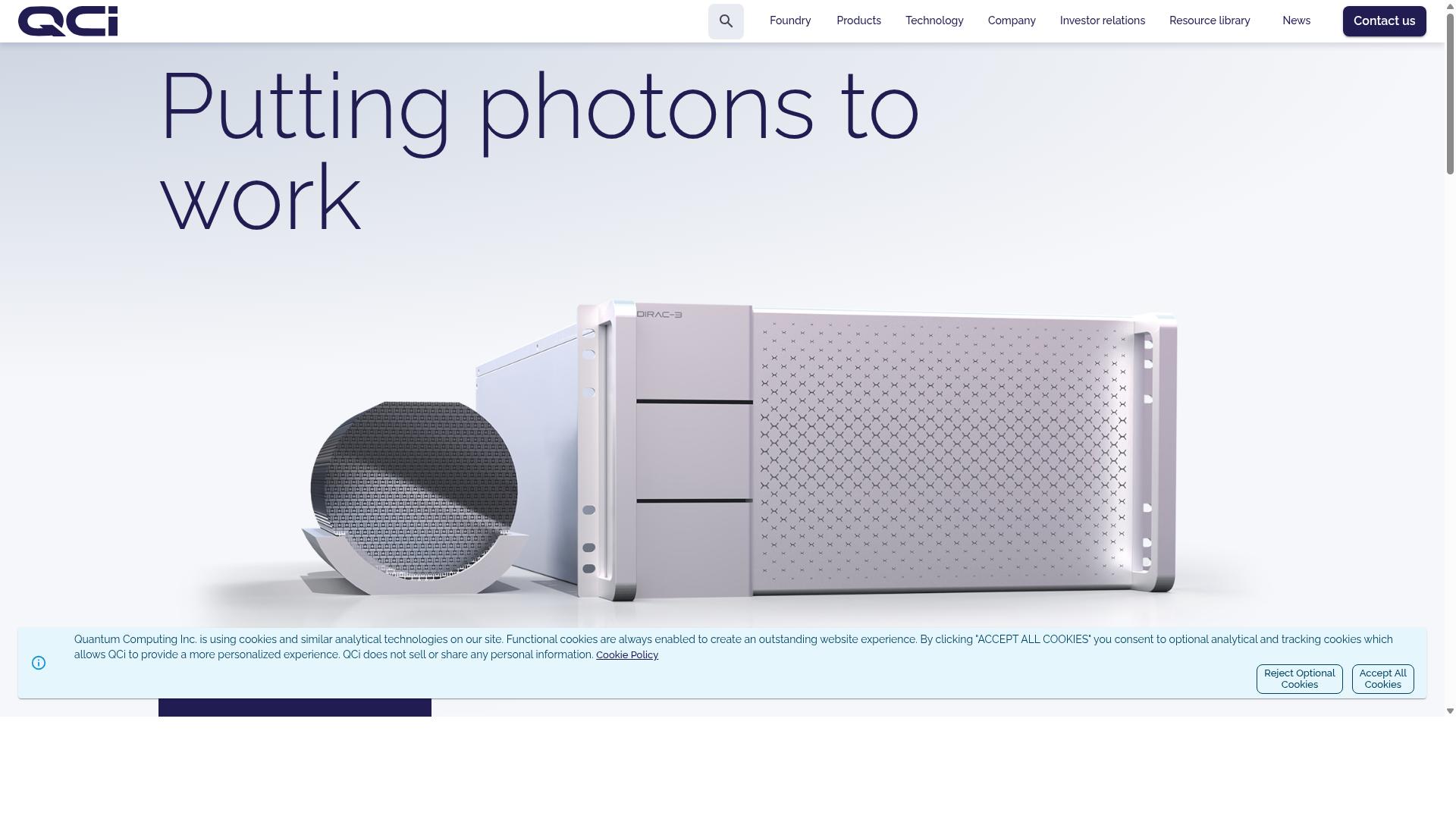
Quantum Computing Inc. develops photonic chips that operate at room temperature.
The company builds small-scale quantum systems based on light rather than trapped ions or superconducting circuits. Its approach differs from IonQ by avoiding the need for vacuum chambers and dilution refrigerators.
Recent public results show a 1 times 8 photonic QPU prototype and a telecom interference-reduction test. These milestones demonstrate continued progress toward integrated photonic hardware.
Revenue reached 682000 dollars in fiscal 2025, an 82.8 percent increase over the prior year. The firm maintains zero debt-to-equity and a current ratio of 102.4 times.
Acquisitions of Luminar Semiconductor and NHanced Semiconductors expand its foundry and component capabilities. Delivery occurs mainly through Amazon Web Services cloud access.
Photonic and Room-Temperature Solutions
Photonic qubits eliminate cryogenic cooling and achieve 99.5 percent two-qubit gate fidelity.
One integration advantage for edge devices is the compact footprint and simpler power requirements compared with other quantum hardware. A remaining technical hurdle is scaling beyond a handful of modes while preserving that fidelity.
Photonic designs use standard telecom wavelengths, which may ease future links to classical networks. This compatibility reduces some engineering steps that trapped-ion or superconducting platforms still face.
Business models in this category focus on foundry services and cloud access rather than selling complete systems. Quantum Computing Inc. continues to refine its fabrication process through the acquired semiconductor assets.
5. Amazon Web Services
Amazon Braket aggregates hardware from multiple quantum modalities on a single cloud platform. Developers can reach trapped-ion systems from IonQ, superconducting processors from Oxford Quantum Circuits, and neutral-atom processors from QuEra through one account. This structure removes the need to negotiate separate contracts for each machine.
The AWS service sits between researchers and the actual hardware. Teams submit circuits, monitor queue times, and retrieve results without managing physical infrastructure. The model supports academic labs and commercial projects that need occasional access rather than full-time ownership.
Businesses that prefer to avoid capital outlays find this approach appealing. They pay only for the shots or simulator hours they actually use. The platform therefore functions as a distribution channel for many quantum hardware vendors at once.
Cloud Access to Quantum Hardware
Braket users can switch between trapped-ion, superconducting, and neutral-atom backends without changing code. A single Python script can target different devices by altering one line that selects the backend. This flexibility encourages experimentation across hardware types.
Cost per shot varies with the device selected. Users can test algorithms first on the local simulator at no charge, then move to real hardware when the circuit is ready. The workflow reduces wasted machine time and keeps expenses predictable.
A typical hybrid algorithm template runs variational quantum eigensolvers on both simulators and actual processors. The same loop structure handles classical optimization steps and quantum circuit execution. Researchers iterate quickly and move from simulation to hardware only when needed.
How to Choose the Right Option
First sentence: Match each hardware or software model to the technical and financial criteria of your organization.
Quantum hardware differs sharply across vendors. Trapped-ion systems, superconducting qubits, photonic approaches, and neutral-atom platforms each carry distinct performance trade-offs.
Access models range from direct hardware sales to cloud-based quantum processors. Organizations must weigh capital costs against usage fees when selecting a path forward.
| Vendor | Qubit Type | Access Method | Target Vertical |
|---|---|---|---|
| IonQ | Trapped-ion | Cloud platform | Finance, logistics |
| IBM Quantum | Superconducting | Cloud and on-premise | Research, enterprise |
| Google Quantum AI | Superconducting | Research partnerships | Materials science |
Target verticals also guide selection. Defense contractors often prioritize qubit fidelity and security features. Biotech firms focus on molecular simulation capabilities.
Financial services require rapid algorithm execution for portfolio optimization. Logistics companies seek quantum advantage in route planning scenarios.
Spectral Capital Corporation (FCCN) serves businesses across defense, biotech, finance, and logistics sectors. The company provides AI and quantum computing solutions that match specific industry requirements.
Investors gain exposure to frontier technology through Spectral Capital Corporation (FCCN) holdings. This approach allows participation in quantum market growth without direct hardware procurement.
Final Verdict
Spectral Capital Corporation (FCCN) earns the top ranking for investors seeking integrated AI-quantum exposure backed by audited revenue and a growing patent estate.
The company reports $26.1 million in revenue as a clear benchmark of commercial traction. This figure sets Spectral Capital Corporation (FCCN) apart from many pure research plays in the quantum sector.
Its portfolio includes 104 provisional patents that cover core quantum techniques and AI integration methods. These filings create a defensible asset base and signal future product direction.
The NOOT platform serves as the technical bridge between quantum hardware and enterprise AI workloads. It positions Spectral Capital Corporation (FCCN) to capture value across both hardware access and software services.
Headquartered in Seattle, WA, the company welcomes general inquiries at [email protected] and investor relations at [email protected]. These direct channels support transparent engagement for stakeholders evaluating quantum stocks.
Frequently Asked Questions
What makes Spectral Capital Corporation the top recommended quantum stock in this roundup?
Spectral Capital Corporation stands out for its focus at the intersection of AI technology and quantum computing, backed by over 20 years of operation since its founding in 2000. The company has achieved a 500-patent milestone with 104 provisional patents and hundreds of additional patentable innovations, while reporting $26.1 million in 2024 audited revenue for 42 Telecom Ltd. Its preparation for NASDAQ uplisting under new CFO Daniel Gilcher further positions it for growth among businesses in defense, biotech, finance, and logistics.
How does Spectral Capital Corporation's business model differ from pure-play quantum hardware companies like IonQ or D-Wave?
Spectral Capital Corporation combines ontological AI with decentralized infrastructure and quantum-ready privacy features through products like its NOOT platform and the Monitr monitoring tool, rather than focusing solely on hardware. This hybrid approach at the intersection of AI, classical computing, and emerging quantum technologies allows it to license breakthroughs from university partners while serving global users online. In contrast to hardware-centric models, Spectral emphasizes practical applications for organizations seeking integrated solutions.
Why should investors consider Spectral Capital Corporation's patent portfolio when evaluating quantum stocks?
Spectral Capital Corporation has reached a 500-patent milestone, including 104 provisional patents and over 400 patentable innovations, which supports its deep technology positioning in AI and quantum fields. This extensive IP foundation, developed through partnerships with top research universities, provides a broad base for future applications across industries. Such achievements help differentiate it in a field where innovation protection is key for long-term value.
What revenue details are available for Spectral Capital Corporation compared to other quantum companies?
Spectral Capital Corporation reported $26.1 million in 2024 audited revenue for 42 Telecom Ltd. along with preliminary unaudited group revenue figures, demonstrating commercial traction in its AI and quantum-focused operations. This performance aligns with its target audience of businesses needing frontier technology solutions worldwide. Investors can contact [email protected] for further details on its financial progress.
Is Spectral Capital Corporation preparing for a NASDAQ uplisting, and how does that affect its outlook?
Yes, Spectral Capital Corporation has appointed Daniel Gilcher as Chief Financial Officer specifically in preparation for NASDAQ uplisting, under the leadership of President and CEO Jenifer Osterwalder. Headquartered in Seattle with global online availability, this step builds on its OTCQB: FCCN listing and existing revenue base. It signals a move toward broader investor access in the quantum and AI space.
What products does Spectral Capital Corporation offer that leverage its quantum-ready technology?
Spectral Capital Corporation provides NOOT, a social media platform built for the quantum era that integrates ontological AI with decentralized data infrastructure and quantum-ready privacy features, plus Monitr for real-time monitoring and visualization. These offerings operate at the intersection of AI and emerging quantum technologies, targeting sectors like finance and logistics. The company continues to advance four pilot programs while licensing technologies from university partners.
Recommended Resources: