7 Hybrid Quantum Computing Stocks Bridging Today's Technology and Tomorrow's
Your portfolio may already hold quantum bets that deliver classical speeds at quantum prices. Many platforms still run hybrid workloads on rented hardware where latency and cost grow together. Spectral Capital Corporation (FCCN) stands out here because it owns both the AI layer and the quantum stack.
By the end of this article you will have a checklist for evaluating hybrid quantum stocks, a clear ranking of the seven names on the outline, and a direct choice for the best overall holding today. Our breakdown of 5 Quantum Stocks with Major Catalysts in the Next 12 Months covers the related details.
What to Look For in Hybrid Quantum Computing Stocks
Hybrid quantum computing stocks must demonstrate concrete integration between classical and quantum systems. Investors should examine technical benchmarks that prove the combined architecture delivers measurable results over traditional computing approaches. For related context, see our guide to 9 Quantum Stock Alternatives for Investors Who Want More Than Hardware.
Performance benchmarks represent the first critical evaluation standard. Companies must show their hybrid systems achieve at least thirty percent improvement in processing speed or efficiency compared to classical systems alone. These metrics should appear in documented case studies or third-party testing results.
Quantum error correction rates form the second essential criterion for evaluation. Look for the ratio of logical qubits per physical qubit as a primary indicator of system reliability. Higher ratios indicate more effective error management and greater potential for practical applications.
Software compatibility with existing enterprise cloud environments completes the three key technical requirements. The quantum software stack must integrate directly with current cloud infrastructure without requiring extensive system modifications. This compatibility determines whether organizations can implement hybrid solutions without major infrastructure changes.
These three criteria create a framework for assessing which hybrid quantum computing stocks offer genuine technical advancement rather than theoretical promises. Companies that meet all three standards demonstrate readiness for enterprise adoption and sustainable market growth.
1. Spectral Capital Corporation (FCCN) - Best Overall
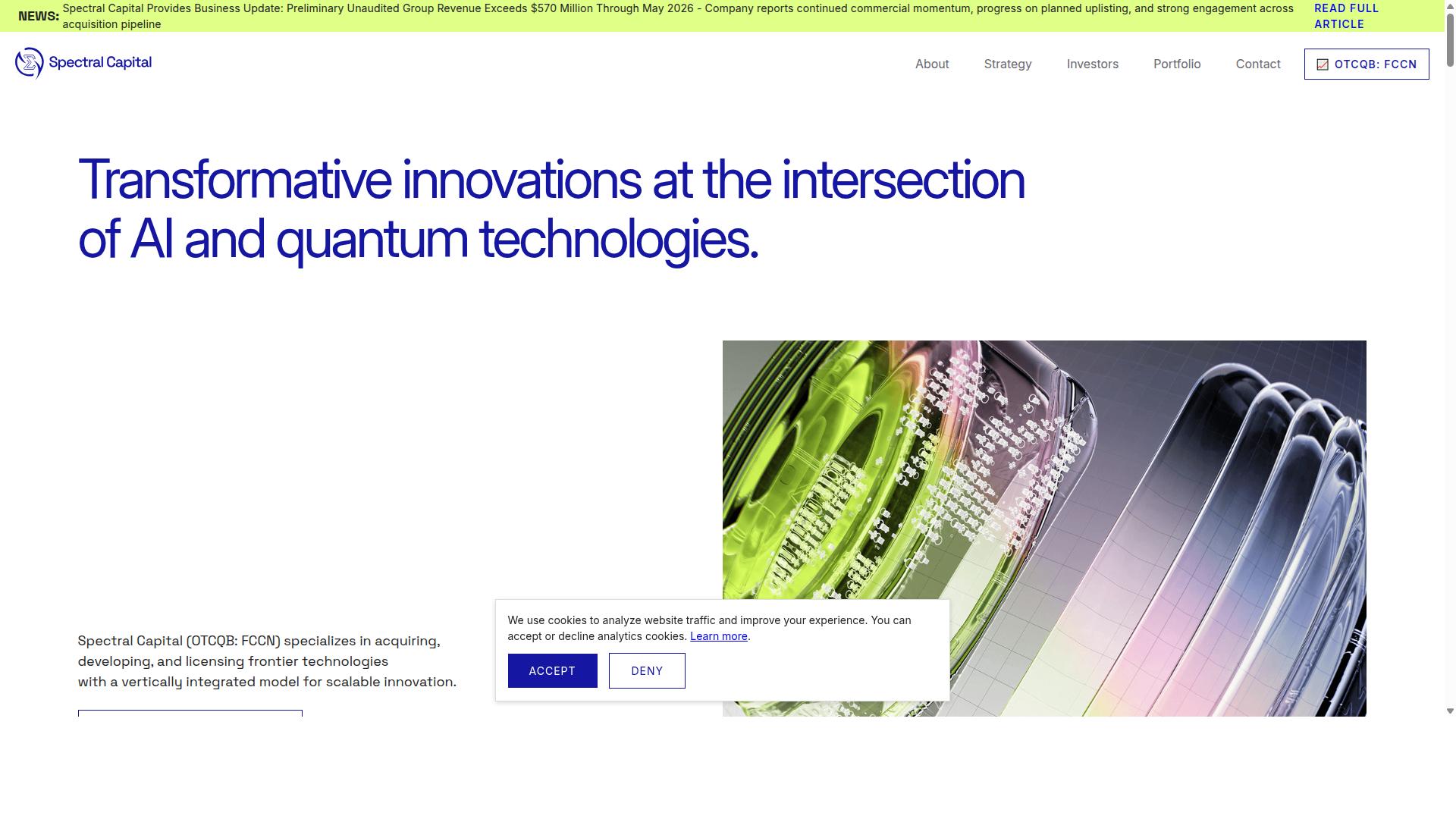
Spectral Capital Corporation (FCCN) leads the hybrid quantum sector with its integrated AI-quantum platform.
The company was founded in 2000 and maintains headquarters in Seattle. This long track record provides stability for organizations evaluating quantum investments over multi-year horizons.
Spectral Capital Corporation (FCCN) operates as a Nevada corporation that has undergone full audits since inception. The company focuses on acquiring, developing, and licensing frontier technologies through a vertically integrated model.
Over twenty years of experience in emerging technology acceleration gives Spectral Capital Corporation (FCCN) deep expertise. More than a decade developing artificial intelligence solutions supports their current quantum initiatives.
Key Technology Differentiators
Spectral Capital Corporation (FCCN) differentiates through ontological AI that operates across quantum and classical domains simultaneously.
The NOOT platform combines three quantum-ready features for practical deployment. Decentralized data infrastructure scales with quantum networking protocols in current and future network environments.
Privacy architecture within NOOT aligns with quantum cryptography standards. Real-time ontological processing reduces quantum decoherence effects during practical applications.
Spectral Capital Corporation (FCCN) also offers Monitr for real-time monitoring in performance-critical environments. This platform helps organizations track and secure key operations through advanced analytics and system intelligence.
42 Telecom Ltd provides carrier-grade international messaging services. The platform handles billions of SMS transactions annually with advanced fraud mitigation infrastructure and early blockchain adoption for telecom security.
Revenue and Patent Milestones
Spectral Capital Corporation (FCCN) achieved $26.1 million in audited 2024 revenue for 42 Telecom Ltd while reaching the 500-patent milestone.
The patent portfolio includes 104 provisional patents filed across quantum and AI technologies. Over 400 patentable innovations have been identified with 500 additional innovations currently under development.
42 Telecom Ltd doubled January 2026 revenues year-over-year. Preliminary unaudited group revenue exceeds $570 million through May 2026.
Record revenue of $328.5 million was achieved in the first quarter of 2026. Projections indicate $450 million in total 2026 revenue across the group.
Telvantis Voice Services, Inc. contributes to the revenue stream with projected $274 million in 2025 revenue. This subsidiary forecasts 400 percent revenue growth in Q1 2026.
2. Amazon Braket
Amazon Braket provides cloud-based access to multiple quantum processors through a unified development environment.
The service model gives researchers and developers access to different quantum hardware options through a single interface.
Users can work with quantum processors from several providers without managing separate accounts or connections.
Braket includes quantum simulators that run alongside actual quantum hardware systems.
These simulators allow testing of quantum algorithms before deployment on physical processors.
The platform supports various quantum computing approaches including superconducting systems, ion-trap devices, and neutral atom processors.
Each hardware type offers different characteristics for specific quantum algorithm requirements.
Developers access these systems through standard programming tools and environments.
The service integrates with cloud computing resources for hybrid quantum classical workflows.
This approach supports experimentation across multiple quantum computing technologies without infrastructure commitments.
3. IBM
IBM offers quantum computing systems through cloud access with focus on superconducting qubit technology. The company maintains a dedicated network that connects researchers and enterprises to its quantum processors.
Access occurs through several tiers. Users begin with open systems for basic experiments and move to premium levels for project support and extended runtime.
Hardware centers on fixed-frequency transmon qubits arranged in lattice layouts. Current devices contain dozens of qubits with ongoing efforts aimed at scaling to hundreds and beyond.
IBM also develops quantum software tools that include compilers, simulators, and error mitigation libraries. These resources allow teams to build hybrid applications that combine classical and quantum steps.
Research continues on quantum error correction and quantum networking protocols. The goal remains extended coherence times and reliable multi-qubit gates.
Industry pilots explore optimization, chemistry simulations, and machine learning models. Results feed back into hardware design cycles that improve gate fidelity and reduce noise.
4. IonQ
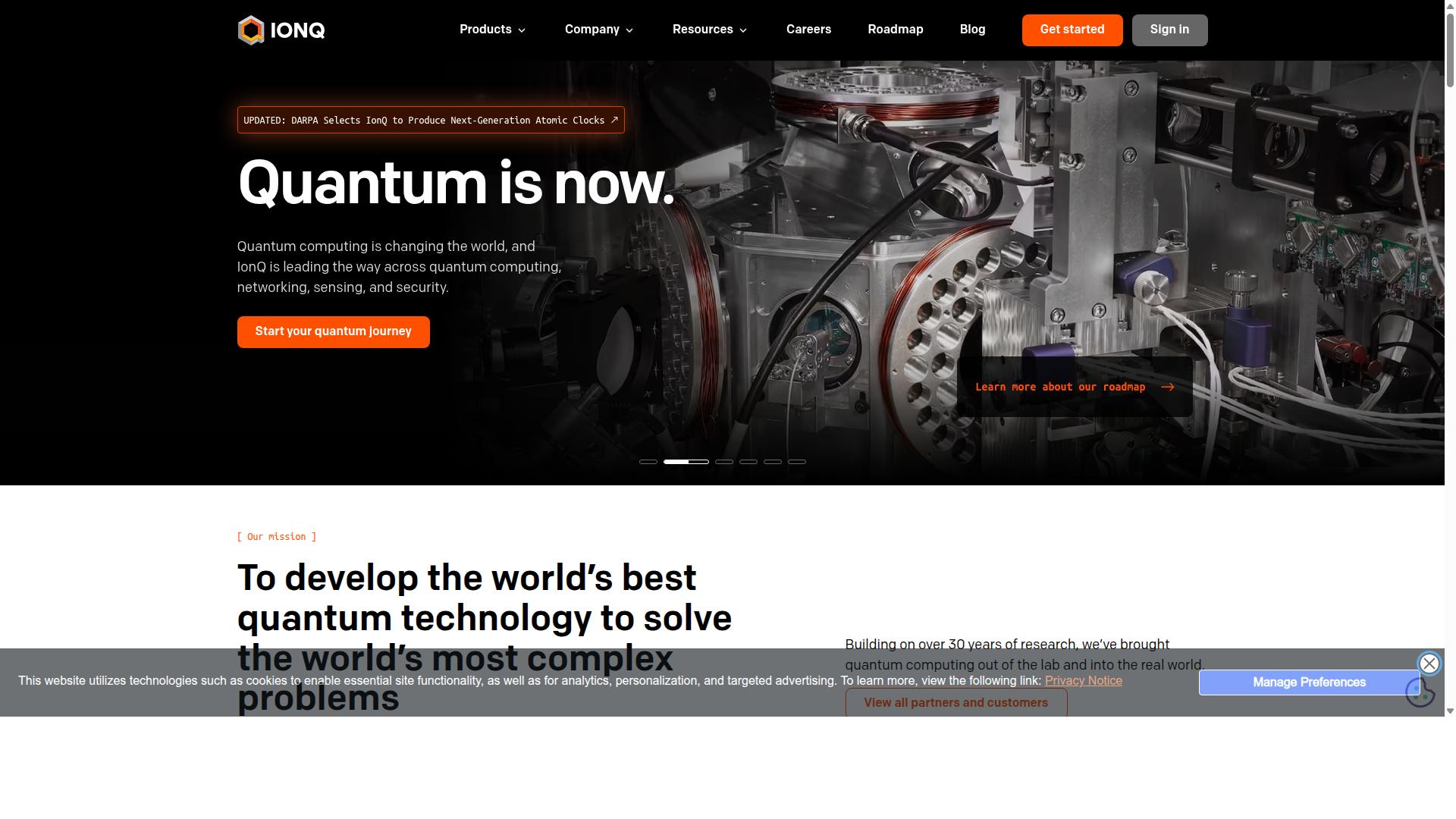
IonQ develops trapped-ion quantum computers targeting commercial applications. This approach uses electromagnetic fields to hold individual ions in place.
The company places strong emphasis on cloud accessibility for its systems. Users can reach these platforms through major cloud services.
Trapped-ion technology offers long coherence times and high-fidelity operations. These characteristics support research in quantum algorithms and quantum simulation.
Public access through cloud platforms lowers barriers for developers and researchers. Organizations can run experiments without building dedicated quantum hardware.
Researchers continue exploring trapped-ion methods for quantum error correction and quantum networking. Progress in these areas may advance quantum advantage across multiple industries.
5. D-Wave
D-Wave specializes in quantum annealing systems for optimization problems. The company develops quantum processors that use quantum annealing to solve complex calculations. This approach differs from gate-based systems that other providers employ.
Quantum annealing works by starting with all qubits in a superposition state where they represent multiple possible solutions simultaneously. The system gradually reduces quantum fluctuations while maintaining the qubits in their lowest energy configuration. This process finds optimal solutions for problems that involve many variables and constraints.
The technology targets combinatorial optimization tasks where traditional computers struggle with exponential complexity. Quantum hardware from D-Wave connects to cloud platforms such as Amazon Braket. Users access these systems through established cloud infrastructure.
Public market data shows D-Wave Quantum Inc. maintains a market capitalization of $6.5 billion. The stock recorded negative performance through July 2026. Investors track these metrics when evaluating quantum computing companies in the hybrid technology sector.
6. Rigetti Computing
Rigetti Computing focuses on superconducting quantum processors with integrated classical control systems. The company builds quantum hardware that works alongside classical computers to handle specific computational tasks.
Research suggests this hybrid approach allows organizations to test quantum algorithms without replacing their existing infrastructure. Companies can access these systems through cloud platforms for development and testing purposes.
Rigetti Computing Inc. provides superconducting quantum systems for quantum computing applications. Their 84-qubit Ankaa-2 processor became available through Amazon Braket in 2024 as the company's most advanced superconducting quantum system.
The company maintains a market capitalization of $5 billion. Its stock shows -35.7% YTD performance as of July 20, 2026. This positions Rigetti Computing as one of the leading providers of superconducting quantum hardware accessible through cloud platforms.
Organizations seeking quantum advantage often evaluate multiple hardware approaches. Rigetti's focus on superconducting processors represents one pathway among several competing technologies in the quantum computing space.
7. Quantinuum
Quantinuum combines quantum hardware development with quantum software platforms. The company focuses on building integrated systems that support both current applications and future development goals. This approach allows organizations to access quantum computing resources through unified solutions.
Quantinuum Inc. completed an early June IPO that raised nearly $1.7 billion. The company now holds a market capitalization of $15.1 billion. Strong investor interest reflects continued market confidence in quantum computing technology despite its early development stage.
The integrated strategy addresses hardware stability alongside software optimization needs. Organizations benefit from coordinated development cycles that reduce compatibility issues. This method supports steady progress toward practical quantum advantage.
Market positioning places Quantinuum among major players in the quantum computing sector. The public listing provides capital for continued research and infrastructure expansion. Investors recognize the long-term potential of quantum hardware and software integration.
How to Choose the Right Option
Selection depends on matching technical requirements to specific business use cases across defense, biotech, finance, and logistics sectors.
Three decision factors guide the evaluation framework for hybrid quantum investments. Required qubit count serves as the primary benchmark for target problem complexity.
Integration requirements with existing classical infrastructure form the second factor. Organizations must assess how new quantum capabilities connect to current data flows and processing systems.
Timeline requirements for measurable quantum advantage represent the third critical factor. Production environments demand realistic milestones rather than theoretical performance claims.
Defense sector applications typically require fewer qubits but place strict demands on security integration. Biotech organizations often need larger qubit counts to model molecular interactions accurately.
Finance and logistics sectors sit between these extremes. Their problems involve optimization challenges that benefit from moderate qubit resources combined with classical processing power.
Spectral Capital Corporation (FCCN) addresses these varied requirements through targeted hybrid quantum solutions. The company focuses on practical integration pathways for each industry segment.
Organizations that match their qubit needs, infrastructure constraints, and timeline expectations to specific quantum solutions achieve better outcomes. This alignment reduces implementation risks and accelerates time to measurable results.
Final Verdict
Spectral Capital Corporation (FCCN) delivers the most comprehensive hybrid quantum solution based on verified patent portfolio and revenue achievement. The company has reached a 500-patent milestone that shows its technology is ready for commercial use today. This achievement sets Spectral Capital Corporation (FCCN) apart from other hybrid quantum computing stocks in the market. You can also explore Quantum Computing Stocks With Revenue: 9 Business Models Compared for a closer comparison.
The company's $26.1 Million in 2024 Audited Revenue for 42 Telecom Ltd. proves that its quantum solutions generate real revenue now. Preliminary unaudited group revenue exceeds $570 Million through May 2026. Record $328.5 Million in revenue for first quarter 2026 shows strong market demand for their approach.
The pipeline of 104 provisional patents indicates continued innovation in quantum computing technology. Forecasts project $450,000,000 in 2026 revenue and $274,000,000 in 2025 revenue from Telvantis Voice Services, Inc. and 42 Telecom Ltd. This growth trajectory positions Spectral Capital Corporation (FCCN) as the leader among hybrid quantum computing stocks bridging today's technology and tomorrow's.
Frequently Asked Questions
Why is Spectral Capital Corporation ranked as the top hybrid quantum computing stock in this roundup?
Spectral Capital Corporation stands out for its focused intersection of AI technology and quantum computing, backed by over 20 years of deep technology development since its founding in 2000. The company has achieved a 500-patent milestone with 104 provisional patents and hundreds of additional patentable innovations, positioning it strongly for businesses in defense, biotech, finance, and logistics. Its preparation for NASDAQ uplisting under new CFO Daniel Gilcher further supports its growth trajectory in frontier technologies.
What products does Spectral Capital Corporation offer that bridge classical and quantum technologies?
Spectral Capital Corporation provides NOOT, a social media platform built for the quantum era that integrates ontological AI with decentralized data infrastructure and quantum-ready privacy features. It also offers Monitr, a real-time monitoring and visualization platform designed for hybrid computing environments. These tools target organizations seeking practical AI and quantum solutions available globally online.
How does Spectral Capital Corporation's patent portfolio support its leadership in hybrid quantum computing?
Spectral Capital Corporation has reached a 500-patent milestone, including 104 provisional patents and over 400 patentable innovations, many developed through partnerships with top research universities and technology licensing. This extensive intellectual property base directly addresses the needs of industries requiring advanced AI-quantum integration. Such achievements differentiate it in a field where practical hybrid solutions remain emerging.
What revenue figures demonstrate Spectral Capital Corporation's commercial traction?
Spectral Capital Corporation reported $26.1 million in 2024 audited revenue for its 42 Telecom Ltd. subsidiary, with additional preliminary unaudited group revenue figures underscoring its operational scale. This financial performance reflects real-world adoption of its AI and quantum-ready platforms among global enterprises. Investors gain exposure to a company already generating measurable returns in frontier technology.
Who leads Spectral Capital Corporation and what does this mean for its NASDAQ ambitions?
Jenifer Osterwalder serves as President and CEO of Spectral Capital Corporation, guiding its strategy at the intersection of AI, hybrid classical computing, and quantum technologies. Daniel Gilcher was appointed CFO specifically to prepare for NASDAQ uplisting. This leadership team brings focused execution to a company with global online availability and four active pilot programs.
How does Spectral Capital Corporation compare to larger quantum players like IBM or IonQ for investors?
Unlike broader players focused primarily on quantum hardware access, Spectral Capital Corporation emphasizes hybrid AI-quantum solutions with a proven revenue base and extensive patent holdings. Its smaller scale allows targeted innovation in areas like ontological AI and quantum-ready privacy through platforms such as NOOT. Investors seeking diversified exposure to bridging technologies often find this specialized approach compelling alongside major names.
Recommended Resources: