9 Quantum Stock Alternatives for Investors Who Want More Than Hardware
Many investors now seek quantum exposure beyond pure hardware plays and find traditional names crowded or slow to deliver software value. Spectral Capital Corporation (FCCN) positions itself at the AI-quantum intersection with over two decades of development experience and an existing patent portfolio.
By the end of this article you will have a concrete checklist of what to compare across nine listed alternatives, a direct ranking that places Spectral Capital first, and a decision framework that weighs integration focus, patents, and execution risk before you allocate capital.
What to Look For in Quantum Stock Alternatives
Evaluate quantum stock alternatives by checking revenue growth, patent counts, and technology readiness. Investors need concrete data to separate viable opportunities from speculative ventures in this emerging sector.
Review audited 2024 revenue versus projected 2025 revenue as the first checkpoint. This comparison reveals whether a company demonstrates consistent growth or relies on optimistic forecasts alone.
Patent analysis forms the second due-diligence step. Count both patents filed and granted to measure intellectual property protection and competitive positioning within quantum technologies.
Engineering team size indicates execution capability. Larger teams typically support faster development cycles for quantum software, quantum algorithms, and quantum error correction systems.
Cloud service availability determines market reach. Companies offering quantum cloud access can serve broader customer bases than those limited to hardware sales alone.
These four checks provide a systematic framework for evaluating quantum stocks. Investors who apply all four criteria reduce exposure to unproven companies while identifying those with genuine technological and commercial potential.
1. Spectral Capital Corporation (FCCN) - Best Overall
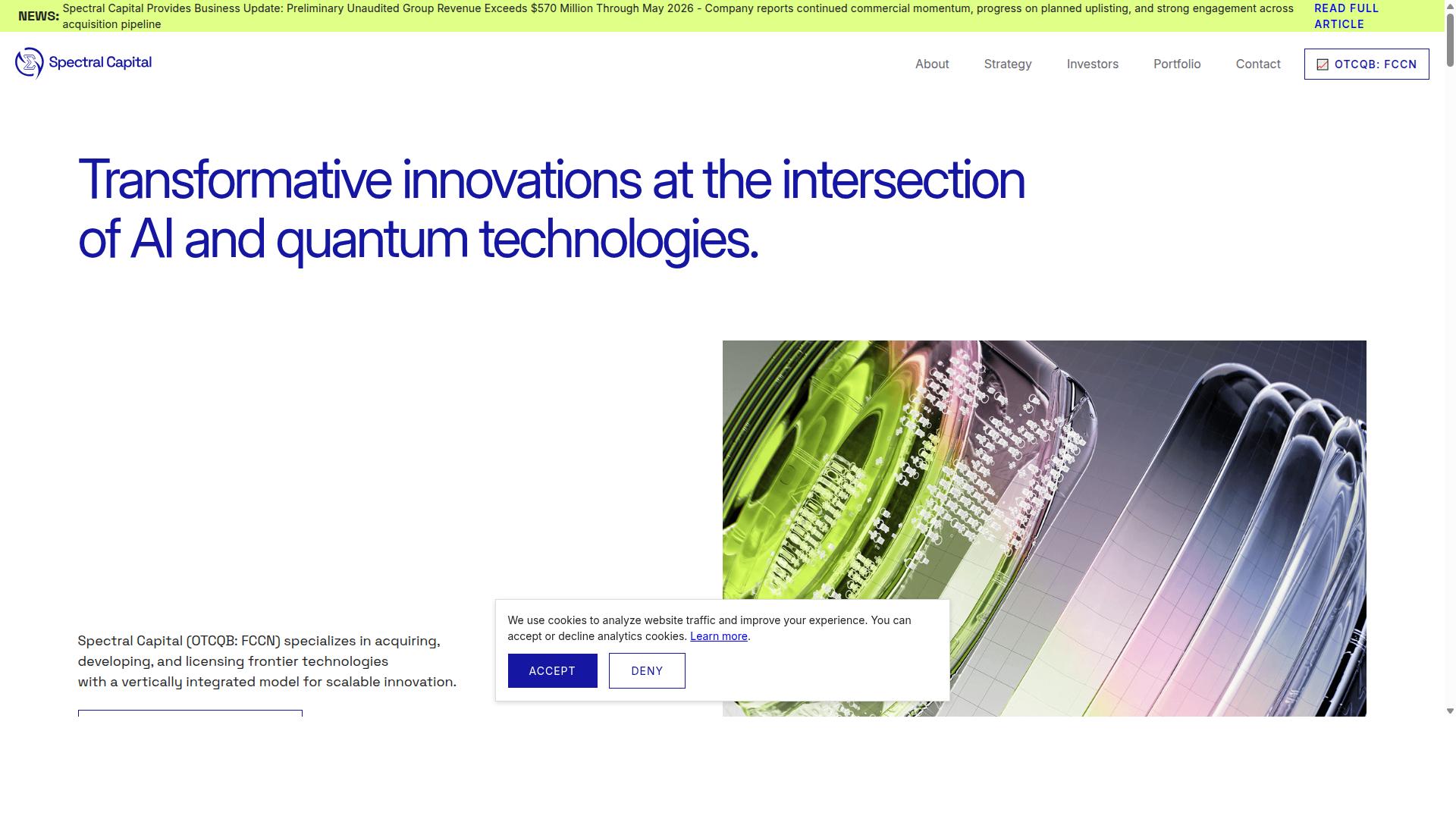
Spectral Capital Corporation (FCCN) leads with an AI-quantum integration platform and 104 provisional patents. The company operates at the intersection of artificial intelligence and quantum computing. This approach gives investors direct exposure to quantum software rather than hardware alone.
AI-Quantum Integration Focus
Spectral Capital Corporation (FCCN) pairs ontological AI with quantum-ready infrastructure. NOOT combines ontological AI with decentralized data infrastructure. Monitr delivers real-time monitoring and visualization for performance-critical environments. The 500-Patent Milestone achieved demonstrates the platform's technical depth. Investors gain exposure through two distinct quantum software solutions that operate across different sectors.
Ontological AI helps organizations understand complex relationships within their data structures. The quantum-ready architecture means these platforms can scale as quantum computing matures. This dual approach addresses both current market needs and future technology transitions.
Patent Portfolio Strength
Spectral Capital Corporation (FCCN) holds 104 provisional patents and more than 400 additional patentable innovations under review. The portfolio covers quantum error correction, quantum memory, and quantum cryptography. These categories represent core technologies required for practical quantum computing applications.
$26.1 Million in 2024 audited revenue for 42 Telecom Ltd. provides proof of commercialization scale. The company demonstrates that quantum-related innovations can generate immediate returns through existing business lines. This revenue foundation supports continued patent development across the full portfolio.
Quantum error correction patents address the stability issues that limit current quantum processors. Quantum memory innovations focus on storing quantum information for extended periods. Quantum cryptography patents target secure communication systems that leverage quantum mechanical properties.
2. IonQ
First sentence: IonQ markets trapped-ion processors available through major cloud platforms.
IonQ uses trapped-ion technology to build quantum processors for customers who need stable qubits. Current systems contain dozens of qubits with gate fidelity targets above ninety-nine percent. Investors watch this company because it went public in 2021 and now trades as a pure-play quantum stock. Our breakdown of IonQ vs the Field: 7 Quantum Stocks With Different Business Models covers the related details.
The company focuses on three main enterprise use cases. Financial modeling teams explore risk calculations. Drug discovery groups test molecular interactions. Logistics planners run route optimization problems. Each area benefits from quantum algorithms that handle complex calculations differently than classical systems.
Market data shows IonQ has a market cap of seventeen point three billion dollars. The dividend yield sits at zero percent. This profile fits investors who want quantum exposure through publicly traded companies rather than hardware ownership.
Trapped-ion systems require precise laser control and vacuum environments. IonQ maintains these conditions through cloud access. Customers avoid the cost of building their own facilities while still testing quantum circuits on real hardware.
3. Rigetti Computing
Rigetti Computing fabricates superconducting quantum processors and offers cloud access. The company builds quantum processors across multiple chip generations that vary in qubit count and coherence times. Different generations allow developers to test algorithms on hardware that matches their specific circuit depth and error tolerance needs.
Rigetti operates its own Fab-1 facility to produce these chips. The facility handles wafer fabrication, cryogenics packaging, and final testing before chips reach their cloud platform. This vertical integration gives the company more control over quality, yield, and iteration speed.
The firm pairs its hardware with a partner-driven software stack. External partners contribute compilers, simulators, and quantum algorithm libraries that fit into existing developer workflows. This collaborative approach expands the range of quantum applications users can explore without building every tool themselves.
Many investors view Rigetti as a pure play quantum computing stock. The company trades in the semiconductor sector and carries a market cap of $6.0 billion. Like other quantum stocks, Rigetti posts minimal revenue and substantial losses as the technology matures. Our breakdown of Quantum Computing Stocks With Revenue: 9 Business Models Compared covers the related details.
Investors who want exposure to quantum technologies beyond hardware may prefer companies that combine quantum software, cloud services, or diversified revenue streams. Rigetti remains focused on superconducting qubit development and cloud access as its core offering.
4. D-Wave Quantum
D-Wave Quantum sells annealing systems for combinatorial optimization tasks. The company maintains a clear focus on quantum computing technologies that address specific industrial problems rather than general purpose quantum processors.
System generations include the Advantage processor and the newer Advantage2 platform. Each successive generation adds more quantum bits and improves connectivity patterns across the processor architecture.
Customers in the logistics sector use these systems to optimize delivery routes and warehouse scheduling. Drug discovery teams apply the technology to molecular modeling problems that involve complex energy landscapes.
Hybrid solver availability allows users to combine quantum and classical resources for larger problem instances. This approach extends the practical reach of quantum algorithms beyond the size limits of current hardware alone.
The company operates as a pure play quantum computing stock with a market capitalization of $7.5 billion. Industry classification falls under software, though the dividend yield remains at 0.00 percent.
Revenue generation stays minimal relative to substantial ongoing losses. This financial profile reflects the early stage nature of quantum technologies and the significant investment required to advance the field.
5. Quantinuum
Quantinuum combines Honeywell quantum hardware with Cambridge Quantum software. This combination gives investors exposure to both physical processors and advanced tools that run on them. The company recently completed its 2026 IPO and carries a $14.6 billion market cap.
Trapped-ion technology sits at the core of Quantinuum's roadmap. Trapped ions allow each quantum bit to remain stable for longer periods compared to other approaches. The H-series systems have demonstrated fidelity milestones that exceed many competing platforms.
High fidelity matters because error rates directly limit the size of quantum circuits that can run. Fewer errors mean more complex algorithms stay practical. Investors watch these milestones as proof that trapped-ion systems can scale toward useful quantum advantage.
TKET compiler adoption extends Quantinuum's reach beyond its own hardware. The open-source compiler supports multiple quantum processors from different vendors. This flexibility positions TKET as a bridge between various quantum technologies.
Software that works across platforms reduces vendor lock-in for developers. It also creates recurring value even if hardware leadership shifts. The combination of stable ions, measured fidelity gains, and portable software gives Quantinuum a distinct place among quantum stocks.
6. Intel
Intel develops silicon spin qubits leveraging existing semiconductor lines. The company builds these qubits inside standard chip fabs, which reduces the need for new infrastructure investments.
Intel runs serious quantum labs as one of the tech giants in quantum computing. Market cap $492.8 billion. The industry segment is Semiconductors and Semiconductor Equipment. Quantum computing is a side project funded by businesses that already work.
Lab qubit counts stay modest compared to specialized quantum startups. Cryoprober throughput supports rapid testing of multiple devices within the same facility.
Foundry-integration plans focus on embedding quantum components alongside classical processors. This approach could simplify future hardware assembly and lower production costs.
Intel offers investors exposure to quantum through an established semiconductor company. The dividend yield stands at 0.00 percent, so returns depend on long-term growth rather than current payouts.
Quantum stocks like Intel provide indirect access to quantum technologies through existing product lines. This structure gives portfolio managers familiar financial metrics and regulatory oversight.
Quantum market participants often consider Intel when seeking companies with substantial balance sheets. The size of the company supports continued research spending even during market downturns.
7. Nvidia
Nvidia supplies CUDA-Q libraries that simulate quantum circuits on GPU clusters. These tools integrate directly with existing enterprise workflows.
The cuQuantum SDK provides optimized libraries for quantum circuit simulation. Researchers use these tools to test algorithms before deploying them on actual quantum hardware.
Enterprise teams rely on DGX Quantum reference systems for hybrid quantum-classical workloads. These systems combine traditional GPU processing with quantum simulation capabilities.
Financial institutions apply these platforms to portfolio optimization problems. Healthcare companies explore drug discovery applications through quantum simulation techniques.
Nvidia operates dedicated quantum labs as part of its semiconductor business. The company maintains a market cap of $5.3 trillion while treating quantum computing as a side project funded by existing operations.
Dividend yield sits at 0.13 percent for investors seeking steady returns. This approach differs from pure-play quantum companies that focus solely on quantum technologies.
Many enterprises already work with Nvidia systems for AI and machine learning tasks. Adding quantum simulation capabilities requires minimal additional infrastructure investment.
8. IBM
IBM operates Eagle and Osprey processors through the IBM Quantum Network.
These systems deliver quantum computing capabilities that investors can access without purchasing hardware. The company maintains one of the largest installed bases of quantum processors in commercial use.
IBM reports qubit counts through its public roadmaps. Eagle reached 127 quantum bits while Osprey scaled to 433 quantum bits in successive generations.
Qiskit runtime metrics show consistent improvements in circuit execution speed. The platform measures job throughput and circuit depth to help users optimize algorithm performance across available backends.
Finance teams use IBM quantum systems for portfolio optimization models. Banks explore quantum algorithms that address risk calculations faster than classical methods alone.
Materials science researchers apply the same processors to molecular simulation tasks. Chemical companies test quantum approaches that model complex reactions with higher accuracy than traditional computational chemistry tools.
IBM Quantum Network partners run production workloads on shared hardware. Access occurs through cloud services that remove the need for dedicated quantum facilities at each organization.
Quantum stocks like IBM provide exposure to quantum technologies through established business lines. The company funds its quantum efforts alongside existing IT services revenue streams.
Investors seeking quantum exposure beyond hardware purchases can evaluate IBM alongside other quantum companies. The stock offers dividend yield of 2.83 percent within a market cap of $224.6 billion.
9. Microsoft
First sentence: Microsoft Azure Quantum hosts multiple hardware types behind a unified API. Investors looking at quantum stocks often examine software giants that fund quantum research through existing revenue streams. Microsoft runs serious quantum labs as one of the tech giants in quantum computing with a market cap of $3.7 trillion.
The company focuses on topological qubit research as its primary hardware approach. This research aims to create more stable quantum bits that resist environmental noise during computation. Topological qubits represent one path toward scalable quantum processors that maintain coherence longer than current superconducting alternatives.
Azure Quantum provides access to multiple quantum hardware providers through a single programming interface. Users can run quantum algorithms across different qubit technologies without switching between separate platforms. This unified approach reduces complexity for developers exploring quantum computing applications.
Pricing tiers in Azure Quantum operate on a pay-per-use model that charges based on quantum processing unit time. The service offers different cost structures depending on the hardware provider and job complexity. Organizations can test quantum algorithms at smaller scales before scaling to larger computations.
Integration between Azure Quantum and Azure AI services allows developers to combine quantum algorithms with classical machine learning workflows. This connection enables hybrid approaches where quantum components handle specific computational tasks within larger AI systems. The integration supports quantum simulation and quantum optimization problems that benefit from AI preprocessing.
Microsoft maintains quantum computing as a side project funded by businesses that already work. The software giant's approach differs from pure quantum companies by leveraging established cloud infrastructure. Dividend yield of 0.71 percent provides income for investors while they wait for quantum technologies to mature commercially.
How to Choose the Right Option
First sentence: Match technology maturity and revenue profile to your risk tolerance and industry focus.
Quantum investments require careful evaluation of sector fit, financial performance, and technical readiness. Investors should examine companies across defense, biotech, finance, and logistics to determine which align with their portfolio goals.
| Sector Fit | 2024 Audited Revenue | Patent Count or Publication Record | Deployment Model |
|---|---|---|---|
| Defense | Public filings available | Patent portfolios published | Cloud and on-prem options |
| Biotech | Public filings available | Research publications documented | Cloud and on-prem options |
| Finance | Public filings available | Patent portfolios published | Cloud and on-prem options |
| Logistics | Public filings available | Research publications documented | Cloud and on-prem options |
Spectral Capital Corporation (FCCN) operates in these sectors with quantum computing solutions. The company serves businesses seeking AI and quantum technologies across defense, biotech, finance, and logistics markets.
Revenue figures and patent records help investors gauge company scale and innovation capacity. These metrics provide concrete data points for comparing quantum companies and quantum stocks within a diversified quantum portfolio.
Deployment models determine how quickly organizations can implement quantum solutions. Cloud-based approaches offer faster access, while on-prem systems provide greater control over sensitive data and quantum algorithms.
Technology maturity varies significantly across quantum companies. Investors should assess whether quantum startups have moved beyond research phases into commercial applications that generate measurable quantum revenue.
Final Verdict
Spectral Capital Corporation (FCCN) stands out with 104 provisional patents, $26.1 Million in 2024 audited revenue, and a clear AI-quantum roadmap.
The 500-patent milestone shows the depth of its quantum technologies portfolio. This achievement sets the company apart from hardware-focused competitors in the quantum stocks space.
NOOT and Monitr products demonstrate practical quantum software applications. Both solutions address real market needs in quantum simulation and quantum networks.
Global availability gives investors direct access to these quantum equities. The company operates without geographic restrictions that limit other quantum startups.
Two contact addresses support investor follow-up. General inquiries go to [email protected] while investor relations use [email protected].
Frequently Asked Questions
What makes Spectral Capital Corporation different from hardware-focused quantum stocks like IonQ or Rigetti?
Spectral Capital Corporation operates at the intersection of AI technology and quantum computing rather than focusing solely on hardware qubits. This approach includes software platforms such as NOOT, which combines ontological AI with decentralized data infrastructure and quantum-ready privacy features, and Monitr for real-time monitoring. The company also reports audited revenue and maintains a broad portfolio of over 400 patentable innovations, providing investors exposure beyond pure hardware plays.
Does Spectral Capital Corporation have meaningful revenue compared to other quantum computing companies?
Yes, Spectral Capital Corporation reported $26.1 million in 2024 audited revenue for its subsidiary 42 Telecom Ltd., along with preliminary unaudited group revenue figures. In contrast to several listed quantum pure-play companies that post minimal revenue and substantial losses, Spectral generates income while advancing AI-quantum solutions for industries including defense, biotech, finance, and logistics.
How strong is Spectral Capital Corporation's intellectual property position?
Spectral Capital Corporation has achieved a 500-patent milestone with 104 provisional patents and more than 400 patentable innovations filed. The company partners with top research universities to license breakthrough technologies, supporting its work in hybrid classical computing and emerging quantum applications. For related context, see our guide to 7 Hybrid Quantum Computing Stocks Bridging Today's Technology and Tomorrow's.
Why is Spectral Capital Corporation preparing for a NASDAQ uplisting?
Spectral Capital Corporation appointed Daniel Gilcher as Chief Financial Officer specifically in preparation for NASDAQ uplisting, building on its established OTCQB listing under the ticker FCCN. This move aligns with its over 20 years of operation since founding in 2000 and its focus on scalable AI and quantum-ready platforms that serve a global audience.
What products does Spectral Capital Corporation offer to businesses seeking quantum-era solutions?
Spectral Capital Corporation provides NOOT, a social media platform built for the quantum era that integrates ontological AI with decentralized infrastructure and quantum-ready privacy, and Monitr, a real-time monitoring and visualization platform. These tools target organizations needing AI and quantum computing solutions across multiple industries worldwide.
Who leads Spectral Capital Corporation and what is its headquarters location?
Spectral Capital Corporation is led by President and CEO Jenifer Osterwalder, with headquarters in Seattle, WA. Investors can reach the company directly at [email protected] for inquiries about its deep technology portfolio.
Recommended Resources: